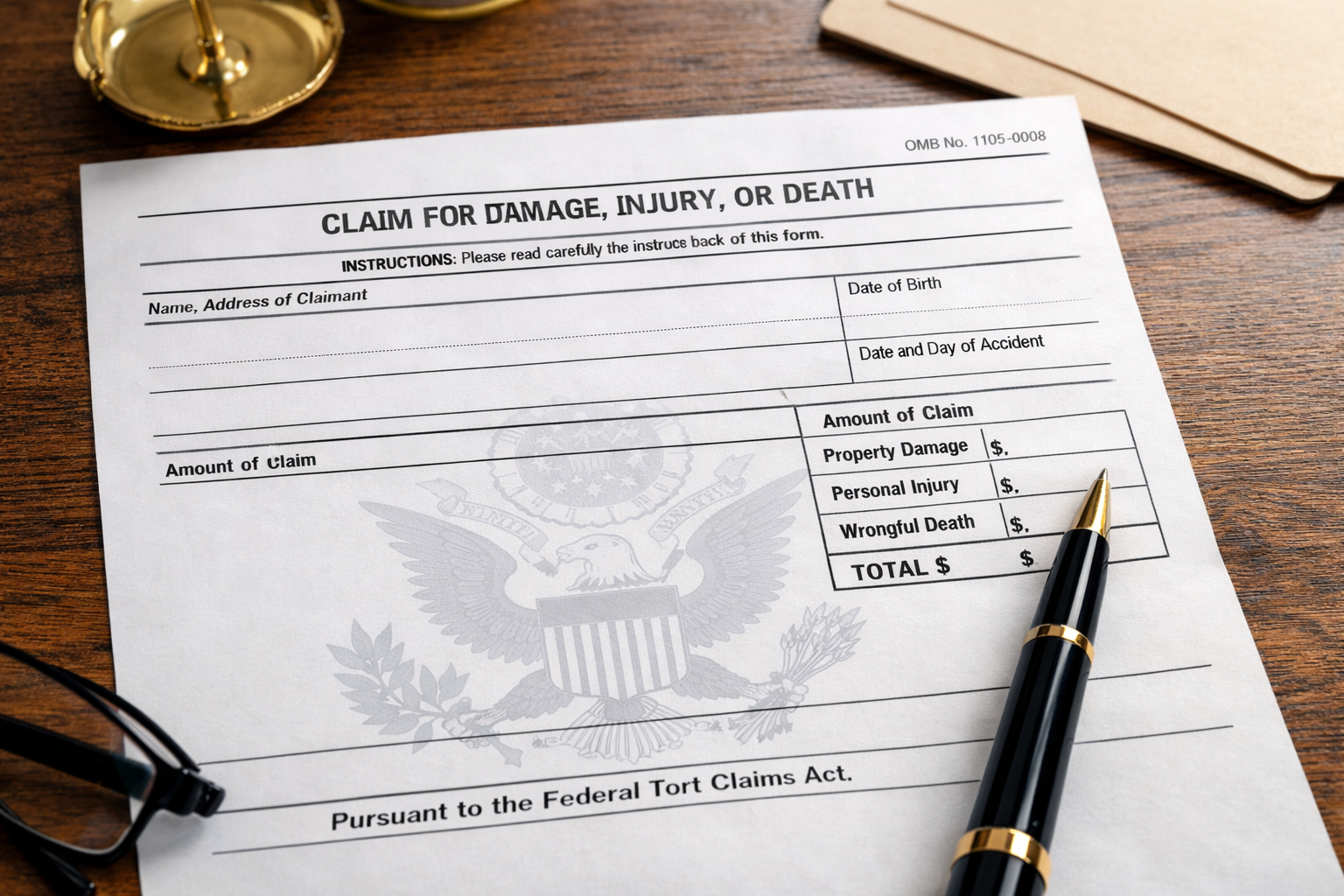
Standard Form 95 is the administrative claim form required before filing a lawsuit under the Federal Tort Claims Act.
Filing a claim against the federal government is not as simple as submitting paperwork.
Under the Federal Tort Claims Act (FTCA), the process starts with Standard Form 95. If you handle that form incorrectly, your claim may fail before it ever reaches a courtroom.
Many valid claims collapse at this early stage.
If you need a step-by-step walkthrough, see our full guide on how to file Standard Form 95 correctly.
Below are five common mistakes that can destroy a claim.
1. Failing to Include a “Sum Certain”
Standard Form 95 requires a “sum certain.”
In plain terms, you must state a specific dollar amount for damages.
The form requires separate amounts for:
-
personal injury
-
property damage
-
wrongful death
You must also include a total amount.
If you do not include a specific dollar amount, courts often treat the claim as if you never filed it properly.
That mistake alone can lead to dismissal.
2. Sending the Claim to the Wrong Federal Agency
You must send Standard Form 95 to the federal agency responsible for the incident.
This step sounds simple. In practice, it causes frequent problems.
For example:
-
immigration detention claims may involve Immigration and Customs Enforcement (ICE)
-
prison claims may involve the Federal Bureau of Prisons
-
military-related claims may involve the Department of Defense
If you send the claim to the wrong agency, you risk delays or outright failure.
In some cases, the deadline passes before anyone corrects the mistake.
3. Missing the Two-Year Deadline
The Federal Tort Claims Act sets strict deadlines.
In most cases, you must file Standard Form 95 within two years of the incident.
If you miss that deadline, you usually lose the claim.
Courts rarely make exceptions.
Because of this, waiting too long can permanently eliminate your ability to recover damages.
4. Providing Incomplete or Vague Information
Standard Form 95 requires a clear description of what happened.
Many claimants provide vague or minimal details. That approach weakens the claim.
Your description should explain:
-
what happened
-
which federal employees were involved
-
how the injury occurred
-
what harm resulted
You should also include supporting documents when possible.
Helpful materials include:
-
medical records
-
photographs
-
witness statements
-
incident reports
Clear, detailed information helps the agency evaluate your claim and reduces the risk of denial.
5. Ignoring the Legal Requirements Behind the Form
Standard Form 95 is only the starting point.
Even if you complete the form correctly, your claim can still fail if it does not meet the legal requirements of the Federal Tort Claims Act.
For example, the government may argue that:
-
the conduct falls within the discretionary function exception
-
the employee acted outside the scope of employment
-
the law preserves immunity in that situation
These legal issues often decide whether a claim succeeds or fails.
Why These Mistakes Matter
FTCA claims involve strict procedural rules.
Courts regularly dismiss cases when claimants ignore those rules.
In many situations, the problem is not the strength of the claim—it is how the claimant filed it.
That is why the administrative claim stage matters so much.
Key Takeaway
Standard Form 95 is not a formality.
It is a required legal step that determines whether your claim can proceed.
If you make mistakes with:
-
deadlines
-
agency identification
-
required information
-
damage amounts
you may lose the claim before it ever reaches court.
Learn How to File Standard Form 95 Correctly
If you plan to file a claim, take the time to understand the full process.
Read the complete guide here:
👉 How to File Standard Form 95 Correctly