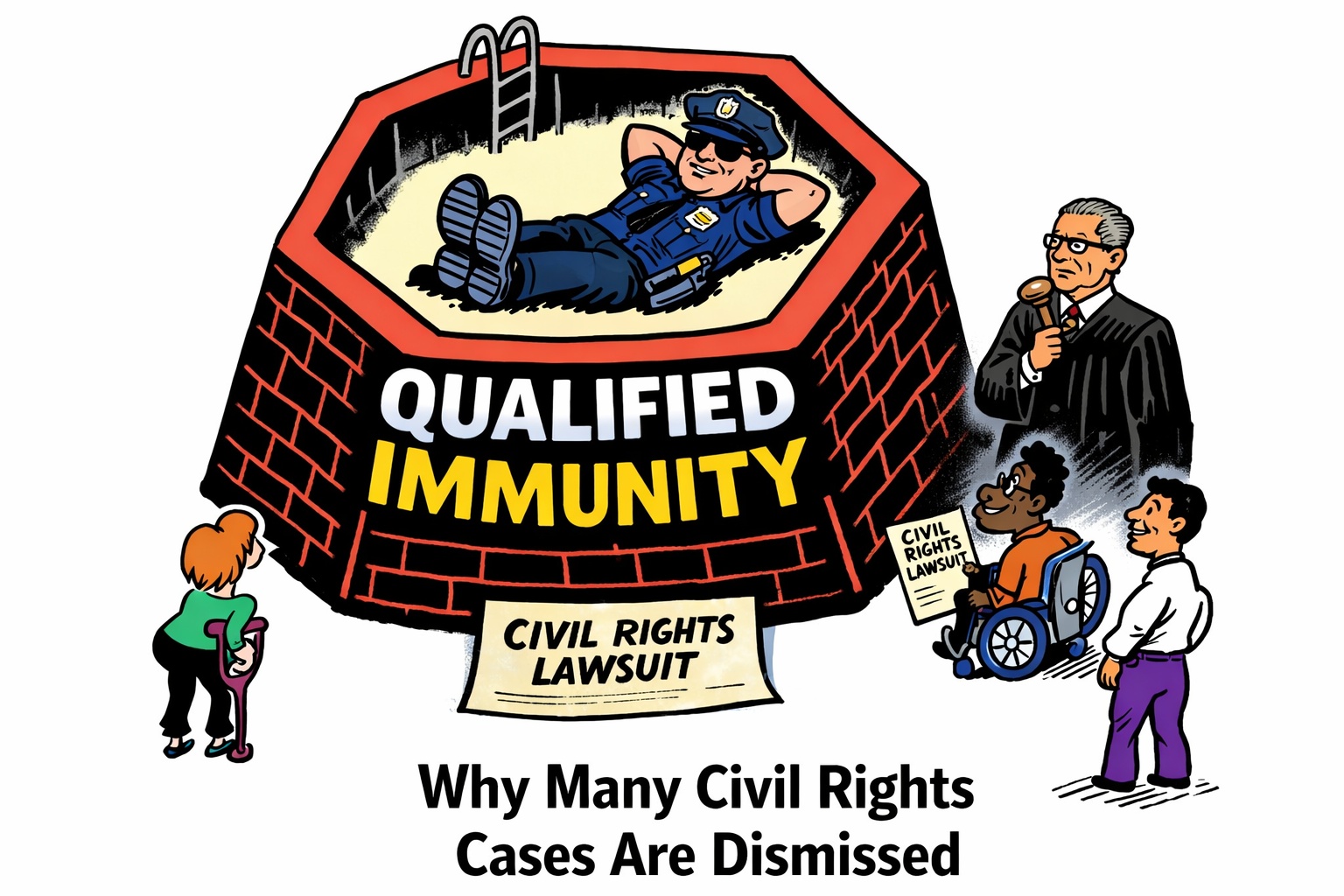
Qualified immunity shields government officials from liability unless they violate clearly established constitutional rights.
What Is Qualified Immunity?
Qualified immunity is one of the most important doctrines in modern civil rights litigation. It often determines whether a lawsuit against a government official—such as a police officer, jail official, or other public employee—can proceed.
In simple terms, qualified immunity shields government officials from civil liability unless they violate clearly established constitutional rights.
This doctrine plays a central role in lawsuits brought under 42 U.S.C. §1983, the federal statute that allows individuals to sue state actors for violations of constitutional rights.
Understanding how qualified immunity works is critical for anyone evaluating a civil rights claim.
The Basic Definition of Qualified Immunity
Qualified immunity is a judicially created doctrine that protects government officials performing discretionary functions from liability for civil damages.
The Supreme Court articulated the modern standard in Harlow v. Fitzgerald, 457 U.S. 800 (1982). The Court held that:
Government officials performing discretionary functions are shielded from liability for civil damages unless their conduct violates clearly established statutory or constitutional rights of which a reasonable person would have known.
This rule replaced an earlier standard that examined an official’s subjective good faith. Instead, the modern doctrine focuses on objective reasonableness—what a reasonable official should have known about the law.
The Court explained that this objective standard allows courts to dismiss weak civil rights claims early in litigation and avoids unnecessary disruption of government functions.
The Two-Step Qualified Immunity Test
Courts evaluate qualified immunity using a two-prong test.
The Supreme Court clarified this framework in Pearson v. Callahan, 555 U.S. 223 (2009).
Under that decision, courts ask two questions:
1. Did the official violate a constitutional right?
The first step asks whether the plaintiff’s allegations, if proven, establish a violation of a constitutional or statutory right.
Examples may include:
-
excessive force by police
-
unlawful searches or arrests
-
denial of medical care in jail
-
retaliation for protected speech
If no constitutional violation occurred, the case ends.
2. Was the right “clearly established”?
Even if a constitutional violation occurred, the lawsuit can still fail if the right was not clearly established at the time of the conduct.
The Supreme Court held that courts may address these two questions in any order, meaning a court may grant immunity without deciding whether a constitutional violation occurred.
What Does “Clearly Established Law” Mean?
The “clearly established” requirement is the most difficult hurdle for many civil rights plaintiffs.
In Ashcroft v. al-Kidd, 563 U.S. 731 (2011), the Supreme Court explained that a constitutional right is clearly established only when:
existing precedent has placed the constitutional question beyond debate.
This standard requires courts to look at prior judicial decisions involving similar facts.
General statements of constitutional principles are usually not enough. Courts must identify a precedent that would have given a reasonable official notice that the conduct was unlawful.
Why the Standard Is So Demanding
The Supreme Court emphasized the strictness of this rule in District of Columbia v. Wesby, 583 U.S. 48 (2018).
The Court explained that qualified immunity protects:
all but the plainly incompetent or those who knowingly violate the law.
In practice, this means that even unconstitutional conduct may receive immunity if prior case law did not clearly prohibit the specific conduct.
Qualified Immunity Is an Affirmative Defense
Qualified immunity is not an element of the plaintiff’s claim. Instead, it is an affirmative defense raised by the defendant.
Courts have repeatedly held that the defendant bears the burden of proving qualified immunity.
However, once the defense is raised, courts often address it early in the litigation process.
Protection from Discovery and Litigation
One of the most significant features of qualified immunity is that it protects officials not just from liability but from the burdens of litigation.
Courts frequently stay discovery while immunity issues are resolved.
Federal courts recognize that a key purpose of qualified immunity is protecting officials from the costs and burdens of litigation, including extensive discovery.
If discovery is permitted at all, courts typically limit it to the narrow issues necessary to decide the immunity question.
Interlocutory Appeals
Qualified immunity also allows government officials to seek immediate appellate review in certain circumstances.
When a court denies qualified immunity based on legal issues, the defendant may file an interlocutory appeal before the case proceeds to trial.
This procedural feature further strengthens the protective effect of the doctrine.
Qualified Immunity Under Arizona Law
Arizona also recognizes a form of qualified immunity for state officials.
The Arizona Supreme Court addressed the doctrine in Chamberlain v. Mathis, 151 Ariz. 551 (1986).
The court rejected absolute immunity and adopted a qualified immunity standard for executive officials.
Under Arizona law, immunity may be lost if an official:
-
Acts outside the scope of their authority, or
-
Acts with malice or reckless disregard for the truth.
This framework reflects the same balancing principle seen in federal law: protecting officials from excessive litigation while preserving remedies for serious misconduct.
Criticism and Ongoing Debate
Qualified immunity has become one of the most controversial doctrines in constitutional law.
Some Supreme Court justices and legal scholars have questioned whether the doctrine is consistent with the text and history of 42 U.S.C. §1983.
For example, Justice Clarence Thomas noted in Ziglar v. Abbasi (2017) that the doctrine may not be grounded in the historical common law backdrop of the Civil Rights Act.
Critics argue that qualified immunity often prevents accountability for serious constitutional violations. Supporters argue that eliminating the doctrine would expose public officials to excessive litigation and discourage effective government service.
Despite these debates, the Supreme Court continues to apply and refine the doctrine.
Can You Still Sue Government Officials?
Yes.
Qualified immunity does not automatically bar civil rights lawsuits.
A case can proceed if:
-
the plaintiff shows a constitutional violation, and
-
existing precedent clearly established that the conduct was unlawful.
In addition, qualified immunity does not apply to:
-
claims against municipalities under Monell
-
official-capacity claims
-
lawsuits seeking injunctive relief rather than damages.
Conclusion
Qualified immunity plays a central role in civil rights litigation.
The doctrine shields government officials from liability unless they violate clearly established constitutional rights that a reasonable official would have known.
Courts apply a two-step analysis focusing on constitutional violations and clearly established law. Because the clearly established standard is demanding, many civil rights cases are dismissed at early stages of litigation.
Understanding how qualified immunity works is essential for evaluating potential claims involving police misconduct, jail conditions, or other constitutional violations.
FAQ (for SEO Rich Results)
What is qualified immunity?
Qualified immunity is a legal doctrine that protects government officials from civil damages unless they violated clearly established constitutional rights.
Does qualified immunity protect police officers?
Yes. Police officers and other government officials may assert qualified immunity when sued for civil rights violations.
Can a civil rights case proceed despite qualified immunity?
Yes. A case can proceed if the plaintiff shows that the official violated a clearly established constitutional right.
Does qualified immunity apply to cities or counties?
No. Qualified immunity applies to individuals, not municipalities. Cities and counties may still face liability under Monell.
Link to your existing posts:
Death in Jail investigations
Jail medical neglect
Federal Tort Claims Act
Civil rights lawsuits
Example anchor text:
civil rights lawsuit for jail death
medical neglect in custody
federal civil rights claims
Civil rights cases involving police misconduct, jail deaths, and denial of medical care often involve qualified immunity defenses. Understanding how the doctrine works is essential when evaluating potential claims.