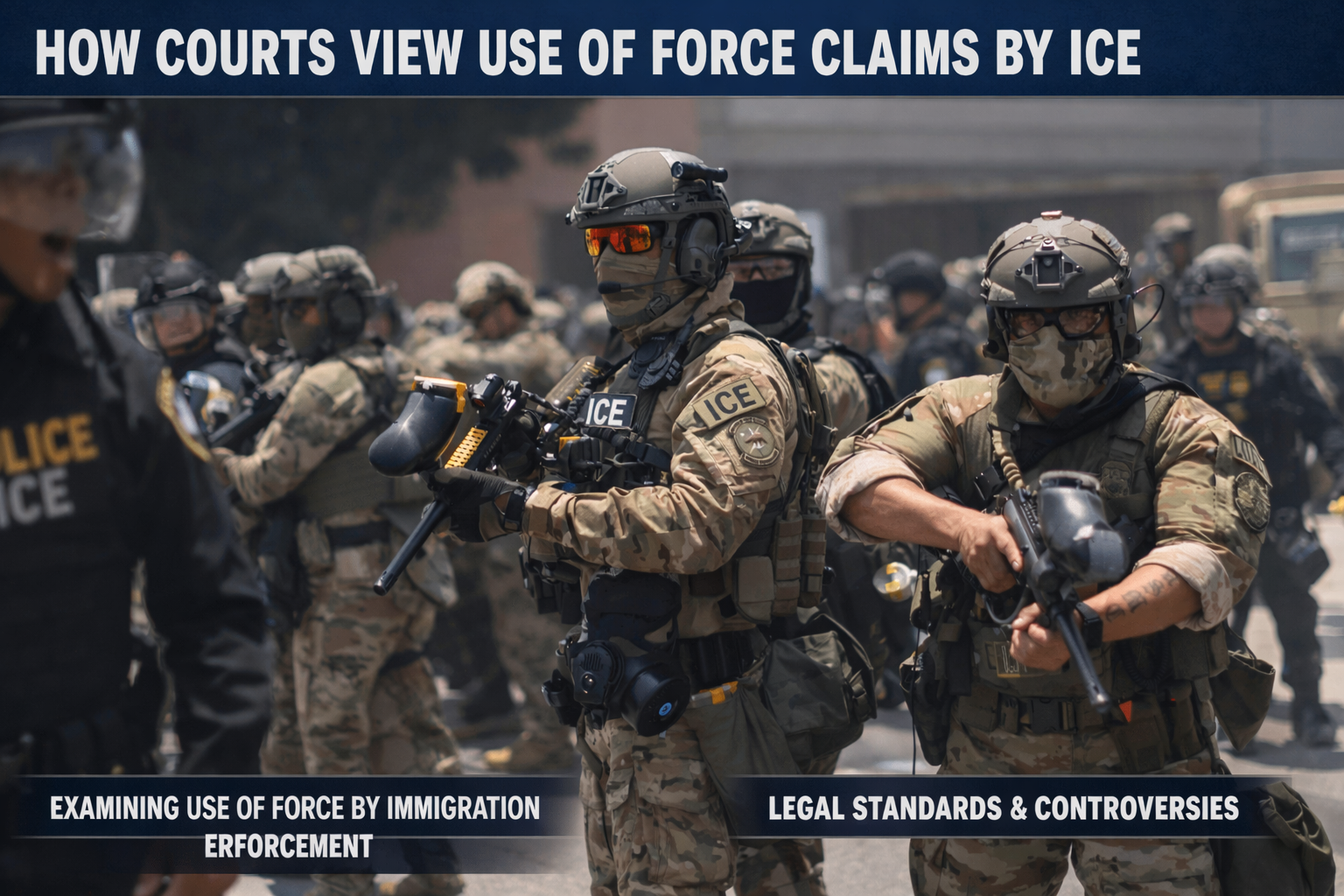
Allegations of excessive force in ICE detention arise when someone reports being beaten, restrained, or struck by federal officers while in custody. The government’s response is often predictable:
“The force was necessary.”
That may be true. It may not.
But it is not the end of the legal analysis.
When federal officers detain a person, they may use reasonable force. They may not use force that is unnecessary or excessive.
In some circumstances, people injured by federal officers can pursue damages through a constitutional claim known as a Bivens action.
The central legal question is simple:
Not whether force was used- but whether the force was justified.
This is the fourth in a series examining ICE detention and civil liability.
Even without full discovery, we know how these cases are analyzed.
Federal Officers May Use Force — But Only Reasonable Force
ICE officers and federal detention personnel may use force to:
-
Maintain order
-
Prevent escape
-
Protect staff and detainees
-
Respond to resistance
But the force must be proportional to the situation.
Courts typically examine several factors:
-
The severity of the situation
-
Whether the detainee posed an immediate threat
-
Whether the detainee was actively resisting
-
Whether less intrusive alternatives were available
Force used for punishment, frustration, or retaliation is not lawful.
The analysis is objective. It does not depend on an officer’s personal explanation after the fact.
The Critical Questions in Any Force Case
Several factual questions often determine whether a force claim has merit:
- Was the detainee restrained?
- How many officers were present?
- Was there an immediate threat?
- Was the force continued after control was achieved?
- Was medical care provided promptly?
For example, if a detainee was handcuffed and surrounded by multiple officers, continued striking becomes difficult to justify.
If force continued after compliance, that matters.
If video evidence contradicts written reports, that matters as well.
These cases often turn on small but critical factual disputes.
Use-of-Force Policies Matter
Federal detention facilities maintain written use-of-force policies governing:
-
Escalation of force
-
Prohibited techniques
-
Reporting requirements
-
Medical evaluation after force
-
Supervisory review
The existence of a policy does not resolve the case. Compliance with that policy does.
If officers failed to:
-
Document the force accurately
-
Seek required supervisory approval
-
Provide medical evaluation
-
Preserve video evidence
Those failures can become central to liability.
Courts distinguish between discretionary operational decisions and violations of mandatory procedures.
The Federal Tort Claims Act (FTCA) Path
Unlike constitutional claims under Bivens, assault and battery claims against federal officers are often brought under the Federal Tort Claims Act.
The FTCA allows claims for certain intentional torts committed by federal law enforcement officers acting within the scope of employment.
That includes assault and battery.
But procedural requirements are strict. Administrative notice must be filed. Jurisdictional defenses are common. Motions to dismiss are routine.
How the claim is framed at the outset matters.
The Government’s Likely Defenses
In federal force cases, the United States typically argues:
-
The officer acted reasonably.
-
The detainee was resisting.
-
The force was within policy.
-
The conduct involved discretionary judgment.
Each of those arguments is fact-dependent.
Video evidence, medical records, and incident reports often determine whether the case proceeds.
The legal standard is not perfection. It is reasonableness under the circumstances.
But unnecessary, disproportionate, or retaliatory force can form the basis of liability.
Contractor Facilities Complicate the Analysis
Many detainees are housed in facilities operated by:
-
Private contractors
-
County jail personnel
-
Hybrid staffing arrangements
The government may argue that the individuals involved were not federal employees. Legal issues involving liability for private ICE detention facilities can significantly complicate these cases.
That raises separate questions:
Who employed the officer?
Who controlled the conduct?
What authority did federal officials retain?
As in other ICE detention cases, the Independent Contractor Exception may be raised early. Determining operational control is often decisive.
What Families Should Do Immediately
If excessive force is alleged in ICE custody:
• Preserve all photographs and medical records.
• Identify witnesses immediately.
• Request incident reports and use-of-force documentation.
• Seek medical evaluation promptly.
• Be aware of strict FTCA administrative deadlines.
Under federal law, a Standard Form 95 must generally be filed within two years of the claim’s accrual. Missing that deadline can bar recovery.
Early investigation is critical. Video retention policies may result in deletion if action is not taken.
Bottom Line
Federal officers may use force. They may not use excessive force.
The legal question is not whether a detainee was difficult. The question is whether the force used was objectively reasonable under the circumstances and consistent with required procedures.
When force crosses that line, the law provides a path to accountability.
This article is part of an ongoing series examining ICE detention litigation under the Federal Tort Claims Act.
As in all federal detention cases, the analysis begins with the facts:
What was the threat?
What force was used?
And was it justified?