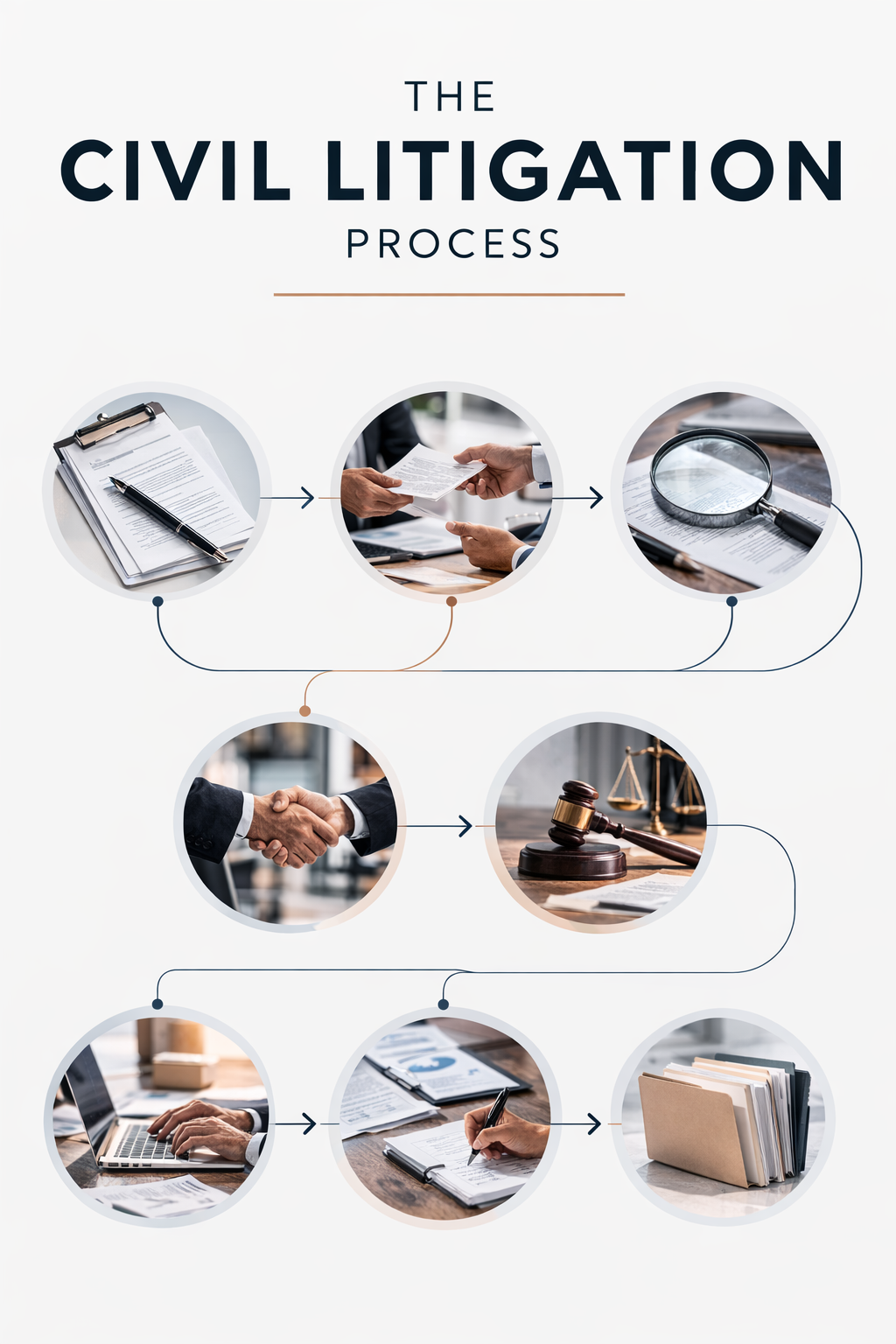
The stages of a civil lawsuit from investigation through trial.
Civil litigation is the legal process used to resolve disputes between individuals, businesses, and government entities. When someone is injured, wrongfully detained, denied medical care, or suffers a violation of their rights, civil litigation provides a way to seek accountability and compensation through the courts.
Many people are unfamiliar with how a lawsuit actually works. Television often portrays litigation as a dramatic courtroom trial, but in reality, most civil cases involve a structured series of steps that unfold over months or years before any trial occurs.
Understanding the civil litigation process helps individuals and families make informed decisions when considering whether to pursue a legal claim.
What Is Civil Litigation
Civil litigation refers to lawsuits that involve private rights and legal claims, rather than criminal prosecution.
In a civil case, the injured party (the plaintiff) brings a lawsuit against the person or entity believed responsible (the defendant). The goal is not punishment, but rather to obtain remedies such as:
-
Financial compensation for injuries or losses
-
Court orders requiring certain conduct
-
Accountability for violations of legal duties
Civil litigation can arise in many contexts, including:
-
Police misconduct and excessive force
-
Jail deaths or denial of medical care in custody
-
Personal injury caused by negligence
Many of these claims are brought in state or federal court, depending on the nature of the legal rights involved. In federal court, the Federal Rules of Civil Procedure control. In Arizona state court, the Arizona Rules of Civil Procedure for the Superior Court control.
The Civil Litigation Timeline
Most civil lawsuits follow a structured path. Although every case is different, the civil litigation process often moves through these core stages.
Investigation
Attorneys review records, evaluate the facts, interview witnesses, and determine whether the evidence supports a legal claim.
Complaint
The case formally begins when the plaintiff files a complaint setting out the facts, legal claims, and requested relief.
Discovery
Both sides gather evidence through documents, written questions, depositions, and, when needed, expert testimony.
Motions
The parties may ask the court to decide legal issues before trial, including dismissal or summary judgment.
Settlement / Mediation
Many civil cases resolve through negotiation, mediation, or settlement conferences before a jury ever hears the case.
Trial
If the dispute does not resolve earlier, the parties present evidence in court and a judge or jury decides the outcome.
Investigation and Case Evaluation
Before a lawsuit is filed, attorneys typically conduct an investigation to evaluate whether a legal claim exists and whether sufficient evidence supports the claim.
This phase may involve:
-
Reviewing medical records and incident reports
-
Obtaining photographs, video, or other physical evidence
-
Interviewing witnesses
-
Consulting with medical or technical experts
-
Evaluating applicable statutes and case law
In civil rights cases involving government misconduct, attorneys often review public records, internal reports, and policies to determine whether constitutional violations may have occurred.
Not every injury or dispute leads to a viable lawsuit. A careful case evaluation helps determine whether litigation is appropriate.
Filing the Lawsuit (The Complaint)
Civil litigation formally begins when the plaintiff files a legal document called a complaint with the court.
The complaint outlines:
-
The parties involved in the lawsuit
-
The relevant facts
-
The legal claims being asserted
-
The relief being requested from the court
After the complaint is filed, the defendant must be formally notified through a process called service of process. The defendant then has an opportunity to respond, typically by filing an answer or a motion challenging the legal sufficiency of the claims.
Once the defendant appears, the court will generally enter a scheduling order to govern the remainder of the case. See our guide to learn more information about the scheduling order.
In federal civil rights cases, defendants sometimes file early motions asserting defenses such as qualified immunity, which can affect how the case proceeds.
Discovery: Gathering Evidence
Once the lawsuit moves forward, the parties enter a phase known as discovery.
Discovery allows each side to obtain evidence from the other in order to understand the facts of the case and prepare for trial.
Common discovery tools include:
Document Requests
Parties may request records such as medical files, policies, internal communications, and investigative reports.
Interrogatories
Written questions that must be answered under oath.
Depositions
Out-of-court testimony taken under oath, where attorneys question witnesses and parties in person.
Expert Witnesses
In complex cases, experts may analyze medical care, use of force, institutional practices, or other technical issues.
Discovery is often the longest phase of civil litigation because it involves extensive document review and witness testimony.
Pre-Trial Motions
As discovery progresses, parties may file legal motions asking the court to resolve certain issues before trial.
One of the most important is a motion for summary judgment, which asks the court to decide whether the evidence supports a legal claim without the need for a jury trial.
Courts evaluate whether a genuine dispute of material fact exists. If the evidence shows that a jury could reasonably rule for the plaintiff, the case proceeds toward trial.
In civil rights cases, courts may also address issues involving constitutional standards and governmental immunity defenses.
Settlement and Mediation
Many civil cases are resolved through settlement before trial.
Courts often encourage settlement discussions through mediation or judicial settlement conferences. During mediation, a neutral mediator works with the parties to explore possible resolutions.
Settlement allows the parties to resolve disputes without the uncertainty, cost, and time associated with trial. However, settlement decisions depend on many factors, including the strength of the evidence, legal risks, and the parties’ willingness to negotiate.
Trial
If a case does not settle or get dismissed, it proceeds to trial.
At trial, both sides present evidence to a judge or jury through:
-
Witness testimony
-
Expert testimony
-
Documentary evidence
-
Cross-examination of opposing witnesses
The jury or judge then determines whether the defendant is legally responsible and, if so, what damages should be awarded.
Trials can last anywhere from a few days to several weeks depending on the complexity of the case.
Appeals
After a trial, the losing party may appeal the decision to a higher court.
An appeal does not involve a new trial. Instead, appellate courts review whether legal errors occurred during the trial that may have affected the outcome.
Appeals focus on legal arguments rather than new evidence.
How Long Does Civil Litigation Take?
Civil litigation often takes time.
The timeline varies depending on the complexity of the case, the number of parties involved, and the amount of evidence that must be reviewed.
Many cases proceed through:
-
Several months of investigation
-
One to two years of litigation
-
Additional time if appeals occur
While litigation can be lengthy, the process allows the courts to carefully evaluate evidence and legal arguments before reaching a decision.
Speaking With a Civil Rights Litigation Attorney
If you believe your rights were violated or a family member was seriously harmed while in government custody, it is important to obtain legal guidance as early as possible.
Civil rights cases often involve complex legal standards, extensive evidence, and strict deadlines for filing claims.
An experienced civil rights attorney can evaluate the facts of the situation, explain the available legal options, and help determine whether pursuing litigation may be appropriate.
Frequently Asked Questions About Civil Rights Lawsuits
These answers explain common issues in civil rights litigation, including Section 1983 claims, qualified immunity, and when government entities may be held liable.
What is a civil rights lawsuit?
A civil rights lawsuit is a legal claim brought against government officials or entities for violating constitutional rights, such as freedom from excessive force, unlawful detention, or denial of medical care.
What is Section 1983?
Section 1983 is a federal statute that allows individuals to sue state or local government officials who violate constitutional rights while acting under color of law.
What is qualified immunity?
Qualified immunity is a legal defense that can protect government officials from liability unless the violated constitutional right was clearly established at the time of the misconduct.
Can cities or counties be sued for civil rights violations?
Yes. Cities and counties may be liable when constitutional violations result from official policies, customs, or systemic failures. These claims are often referred to as Monell claims.