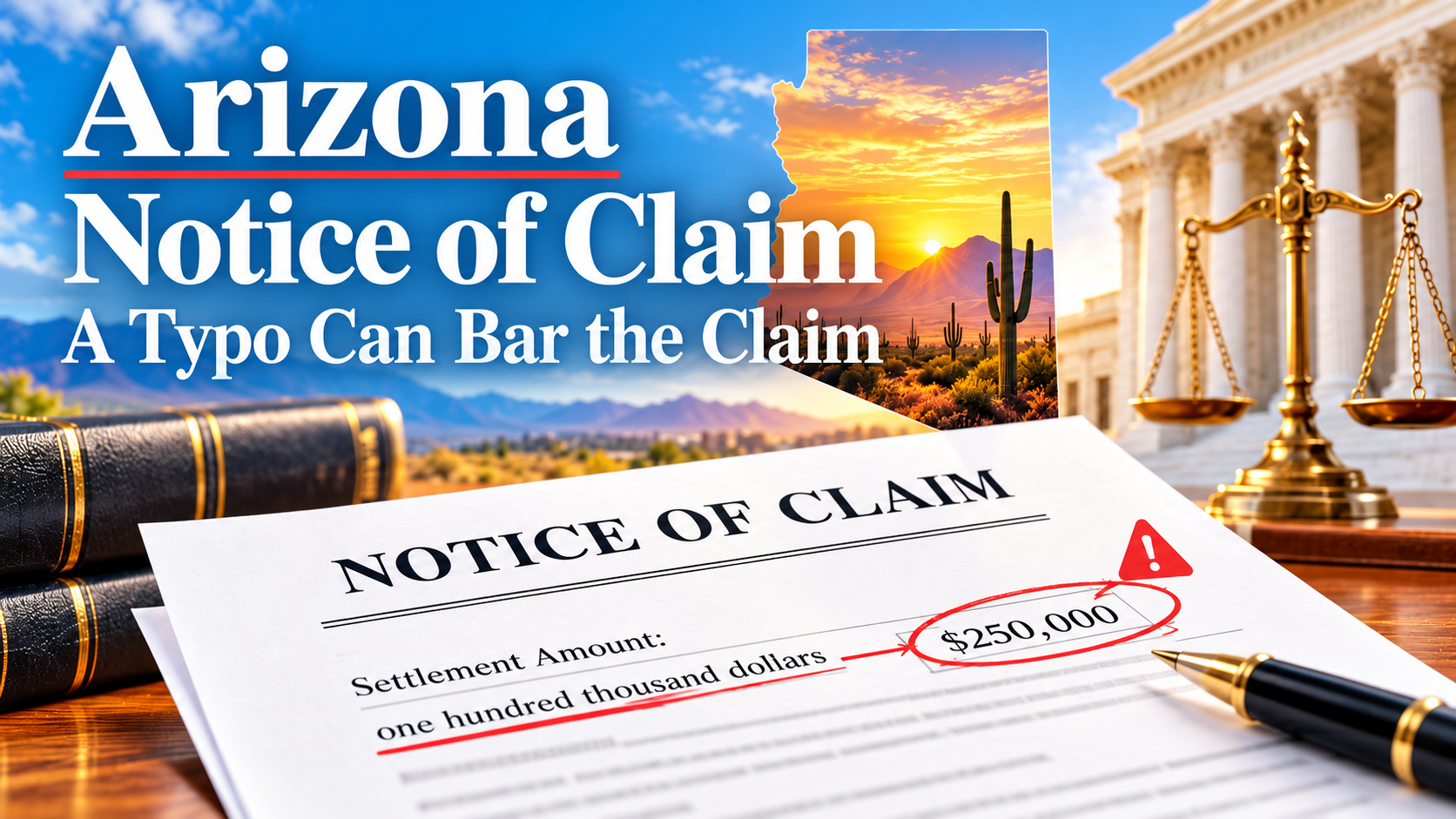
A conflicting settlement amount in an Arizona Notice of Claim can invalidate the claim under A.R.S. § 12-821.01.
A single mistake in an Arizona Notice of Claim can have extraordinary consequences.
The Arizona Supreme Court recently demonstrated just how unforgiving the rule can be in Terborg v. Town of Payson. (Sept. 24, 2026)
The claimant’s Notice of Claim offered to settle his case for:
“one hundred thousand dollars ($250,000).”
One amount appeared in words. A completely different amount appeared in numbers.
The difference ultimately cost the claimant his state-law claim.
What Happened in Terborg v. Town of Payson?
In June 2023, a Payson Police Department dog mistakenly attacked and injured Joseph Terborg while the dog was pursuing a suspect.
Terborg timely submitted a Notice of Claim to the Town of Payson.
After describing his claim, he offered to settle for “one hundred thousand dollars ($250,000).” The Town did not accept the offer during the statutory 60-day period, and Terborg later sued.
The Town argued that the conflicting figures meant the notice did not contain the “specific amount” required by A.R.S. § 12-821.01.
The Arizona Court of Appeals Sided With the Claimant
The Arizona Court of Appeals initially held that the Notice of Claim was valid.
Its reasoning was fairly intuitive.
The court applied principles used to interpret conflicting contract language. It concluded that the written words controlled the numerical figure.
Because the notice said “one hundred thousand dollars” before placing “$250,000” in parentheses, the Court of Appeals treated $100,000 as the settlement offer.
The court relied in part on the idea that parenthetical material is subordinate to the principal text and that words traditionally prevail over conflicting numbers. It therefore found an unambiguous $100,000 settlement offer.
That ruling did not survive.
The Arizona Supreme Court Reverses
On September 24, 2026, the Arizona Supreme Court rejected the Court of Appeals’ approach.
The Supreme Court held that the conflicting amounts made the settlement demand ambiguous.
A reader could not determine from the Notice of Claim whether the claimant intended $100,000 or $250,000.
That was enough to make the notice defective.
The Court refused to require the Town to apply contract interpretation rules, decide which portion of the sentence should control, or contact the claimant and ask what he actually meant.
Instead, the burden remained on the claimant to state one definite amount.
A Clerical Error Is Still an Error
Perhaps the most important part of Terborg is the Court’s treatment of what everyone recognized was a mistake.
The Supreme Court accepted that Terborg had made a clerical error.
But that did not save the claim.
The Court reasoned that the mistake was not merely a harmless technical defect because it prevented the Town from knowing the amount necessary to settle the claim. The supporting facts did not solve the problem because they were broad enough to support either $100,000 or $250,000.
Arizona’s Notice of Claim statute demands strict compliance.
Why Didn’t the Town Have to Ask for Clarification?
This is probably the most striking practical aspect of the decision.
The Town undoubtedly understood that somebody had made a mistake.
But Arizona law did not require the Town to pick up the phone and ask:
“Did you mean $100,000 or $250,000?”
The Supreme Court held that public entities have no obligation to help claimants satisfy the statute.
Nor must they apply contract doctrines or rules of legal drafting to reconstruct what the claimant probably intended.
The claimant has the burden to provide “a single, identifiable amount that unequivocally communicates what will resolve the claim.”
Terborg Continues Arizona’s Strict Approach
Terborg did not emerge from nowhere.
For years, Arizona courts have required a Notice of Claim to include a definite settlement amount.
In Deer Valley Unified School District No. 97 v. Houser, the Arizona Supreme Court rejected demands using words such as “approximately,” “or more,” and “no less than.”
Those phrases left uncertainty about the actual settlement amount.
Then, in City of Mesa v. Ryan, the Court rejected an offer to settle for the greater of $1 million or applicable insurance policy limits. The unknown policy limits prevented the government from determining the exact settlement amount from the notice.
Terborg takes the same principle to its logical—and fairly harsh—conclusion.
Even when everyone can see that a claimant probably made a typo, the government does not have to determine which number was intended.
What Does Terborg Mean for Arizona Claimants?
The practical rule is simple:
There should be one—and only one—settlement amount in an Arizona Notice of Claim.
If the amount appears more than once, every reference should match.
For example, do not write:
Five hundred thousand dollars ($250,000).
Do not write:
$500,000 or policy limits, whichever is greater.
And avoid qualifiers such as:
approximately $500,000
or
no less than $500,000.
The statute does not ask the government to figure out what the claimant probably meant.
Proofread the Demand Separately
There is a practical drafting lesson here for lawyers.
Before serving an Arizona Notice of Claim, perform a separate review devoted solely to the demand amount.
Check:
- the written amount;
- the numerical amount;
- the amount stated in the introduction;
- the amount stated in the conclusion;
- amounts assigned to multiple claimants;
- references in attachments; and
- any qualifying language surrounding the demand.
A $150,000 typo in Terborg was not harmless.
It was dispositive.
The Larger Lesson
Arizona’s Notice of Claim statute creates a short deadline and demands precision.
A claimant generally has only 180 days after accrual to serve a proper notice. The notice must explain the factual basis of the claim, provide facts supporting the demand, identify a definite settlement amount, and reach the correct recipient.
Terborg reinforces the central rule:
Close enough is not enough.
For a broader explanation of the statute, see our [Guide to Arizona Notice of Claim Requirements].